


I’ve spent my career inside high-growth GTM orgs. Some were successful (Flock $7.5B), others weren’t. This newsletter is where I write about what I learned, and what it cost me.
Subscribe now to get 5+ templates (Ideal rep profile, TAM analysis, etc) you can use today to build your GTM org.
I’ve hired over 60 account executives in the last three years.
I’ve failed a lot. Bad hires that cost us quarters. Candidates I let slip because I wasn’t paying attention. Roles I filled with the wrong profile because I hadn’t done the work up front.
I’ve also gotten it right.
At Flock Safety ($7.5B valuation), we built a new segment from 0 to 50 reps in 7 quarters.
At Edia, we hired 7 AEs in 10 weeks at a Series A edtech company (a vertical most AEs are not interested in) by going on offense and treating recruiting the way the best AEs treat pipeline generation.
I’m writing this in response to Jake Cronin’s (CEO of Siro) post about needing to hire 5 AEs in 5 weeks. I’ve structured the specifics around Siro so you can see the framework applied to a real company in real-time. But everything here applies to your org. Adapt freely.
If you’re a founder hiring your first sales team, or a VP trying to scale from 3 AEs to 15, this is for you.
The thing I wish I’d known earlier
When I took my first sales leadership role, I thought the most important thing was helping reps close deals.
I was wrong.
The more experience I gain, and the more AI removes friction from operational work, the more I believe that the single most important activity of a sales leader is recruiting elite talent.
Recruiting is pipeline generation for a sales leader.
That reframe changed how I operate. Our team blocks time for it. We track it weekly. We don’t wait until a seat opens. We’re always building a bench.
The best hire I ever made came from an InMail I sent when I had no open roles. Six months later, I had a seat and they were the first call I made.
Poor recruiting is the most common reason sales leaders fail. I’ve watched it happen. I’ve been the reason it happened.
The uncomfortable part: only the hiring manager can do this well. Not your recruiter. Not HR. Not a third-party search firm. You.
Delegate this and you’re outsourcing the most important piece of building a durable organization.
Align on the plan
Most leaders start recruiting before answering the foundational questions. I’ve made this mistake. You source 50 candidates, get to final rounds, and realize your comp structure is wrong or your quota is too aggressive to attract the person you actually need.
I am not going to go deep on this in this essay, but know this, without a clear 36 month rolling ARR / Revenue target it’s impossible to build a clear hiring roadmap.
(If a full post on capacity planning would be helpful, let me know in the comments below)
Do this work first.
Align on your 24-month target. What does the number need to be? Work backward from there.
Align on segmentation. Are you hiring Enterprise, SMB, or both? These are different profiles. Do not conflate them.
Align on quota and OTE by segment. What’s the quota? What’s the OTE? What’s the bookings-to-OTE ratio? If you can’t answer these clearly, you’re not ready to hire.
Align on ramp time. Enterprise ramp is typically 6-9 months before full quota. SMB might be 3-4. Model this. It matters for when you hire, not just how many.
Build the capacity model. Now you know the number, the segment, the comp, and the ramp. Back into how many reps you need and in what sequence. Hiring 5 people at once is usually worse than hiring 2 strong people early. Sequence matters.
For this post, we’ll use the details Siro has shared publicly: 5 Enterprise AEs / $250k OTE ($125k/$125k) / NYC / 5 weeks
Step 1: Identify: Nail the ideal rep profile (IRP)
This is where most leaders fail. Not because they don’t have a profile. They do. It’s just too vague or too aspirational for the stage of company and the reality of the opportunity.
The classic mistake: searching for a unicorn without a unicorn pitch.
“I want a $2M closer who’ll relo, take a pay cut, thrive in ambiguity, and be excited about a market they’ve never sold into.” That person may exist, but they’re not leaving a cushy job with RSUs vesting every month without a really compelling reason.
You have to earn that conversation.
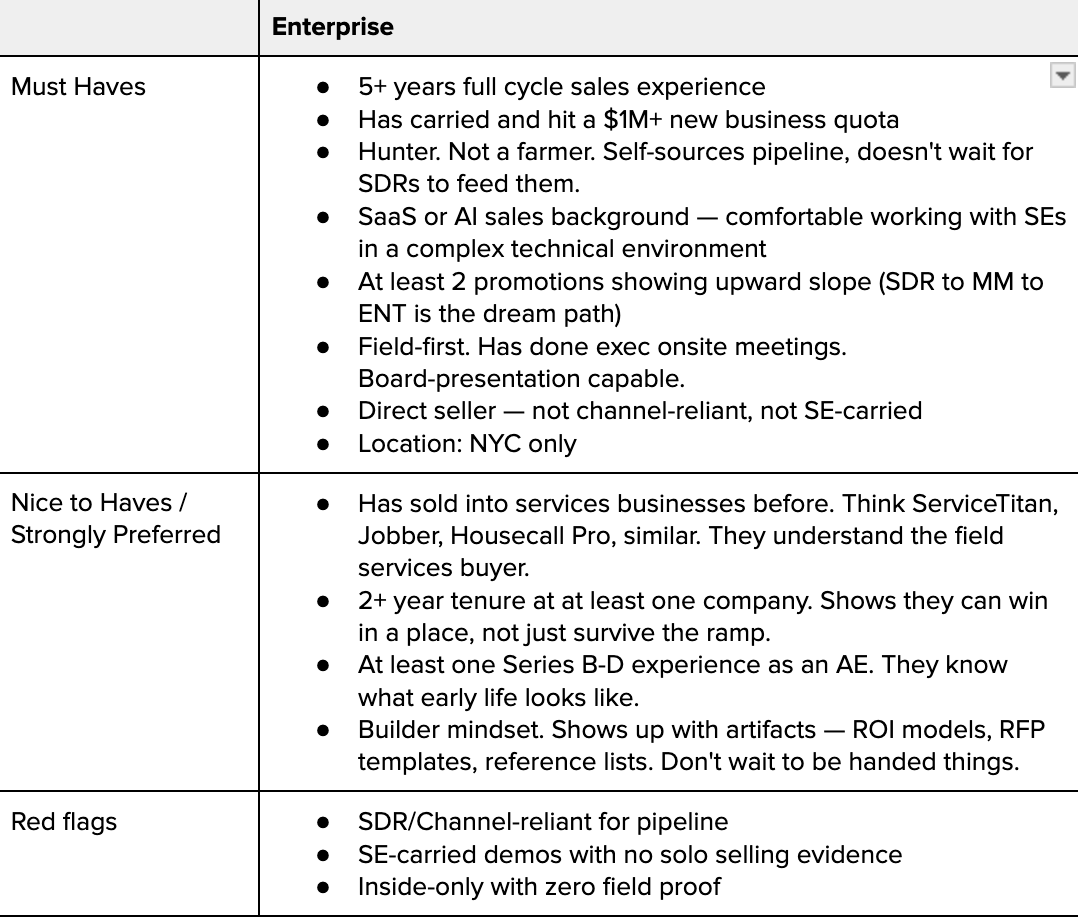
Here’s the IRP I built out for Siro from what I could learn from their site and job postings.
Build your Ideal Rep Profile (IRP)
How to build your list
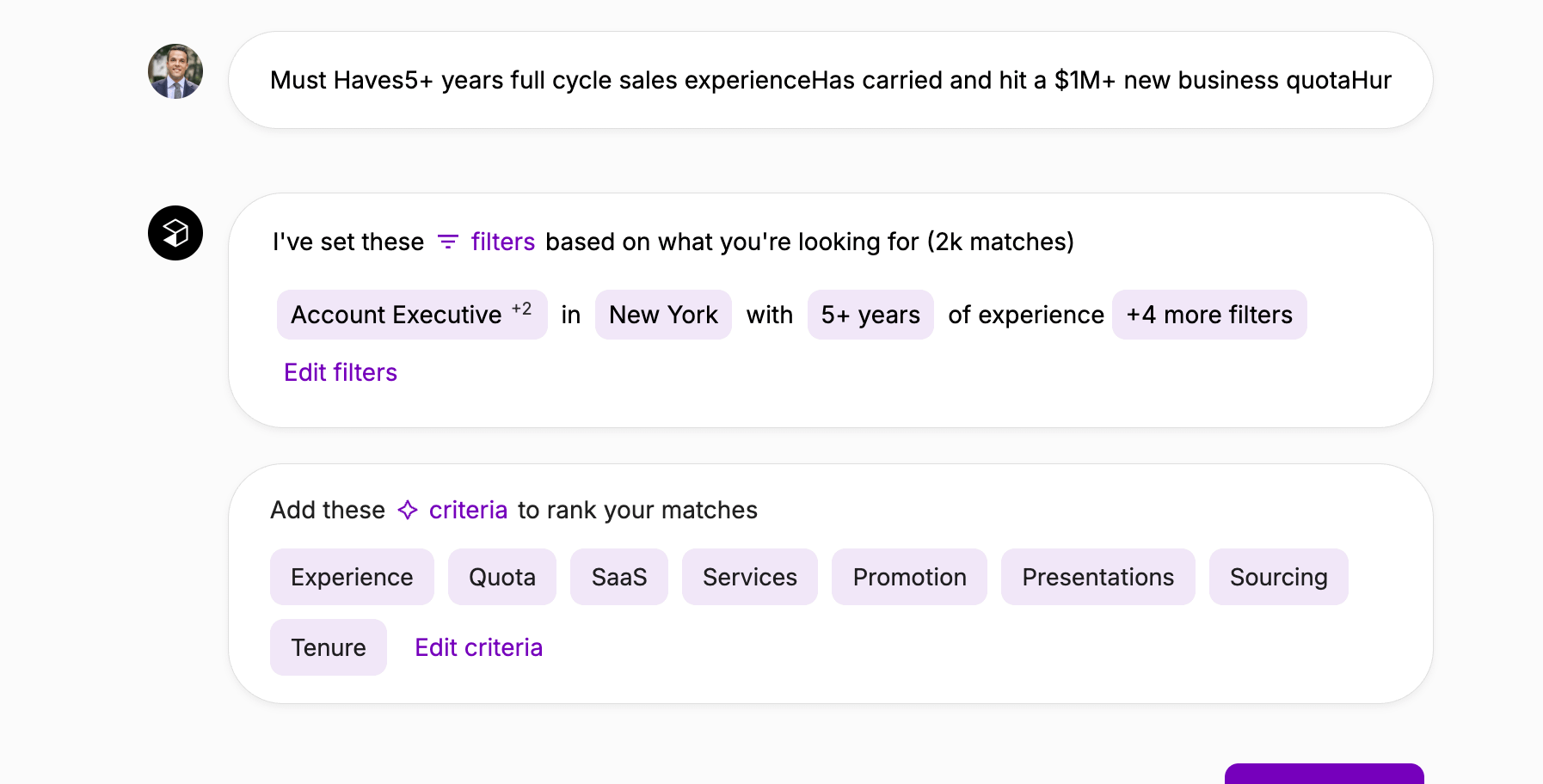
I copy and paste my IRP components directly into Juicebox (see below) and its AI functionality auto-populates the specific filters, criteria that I want to search for. This saves HOURS of time that I would normally put into building boolean searches in LinkedIn.
Now I have a list of 500+ candidates.
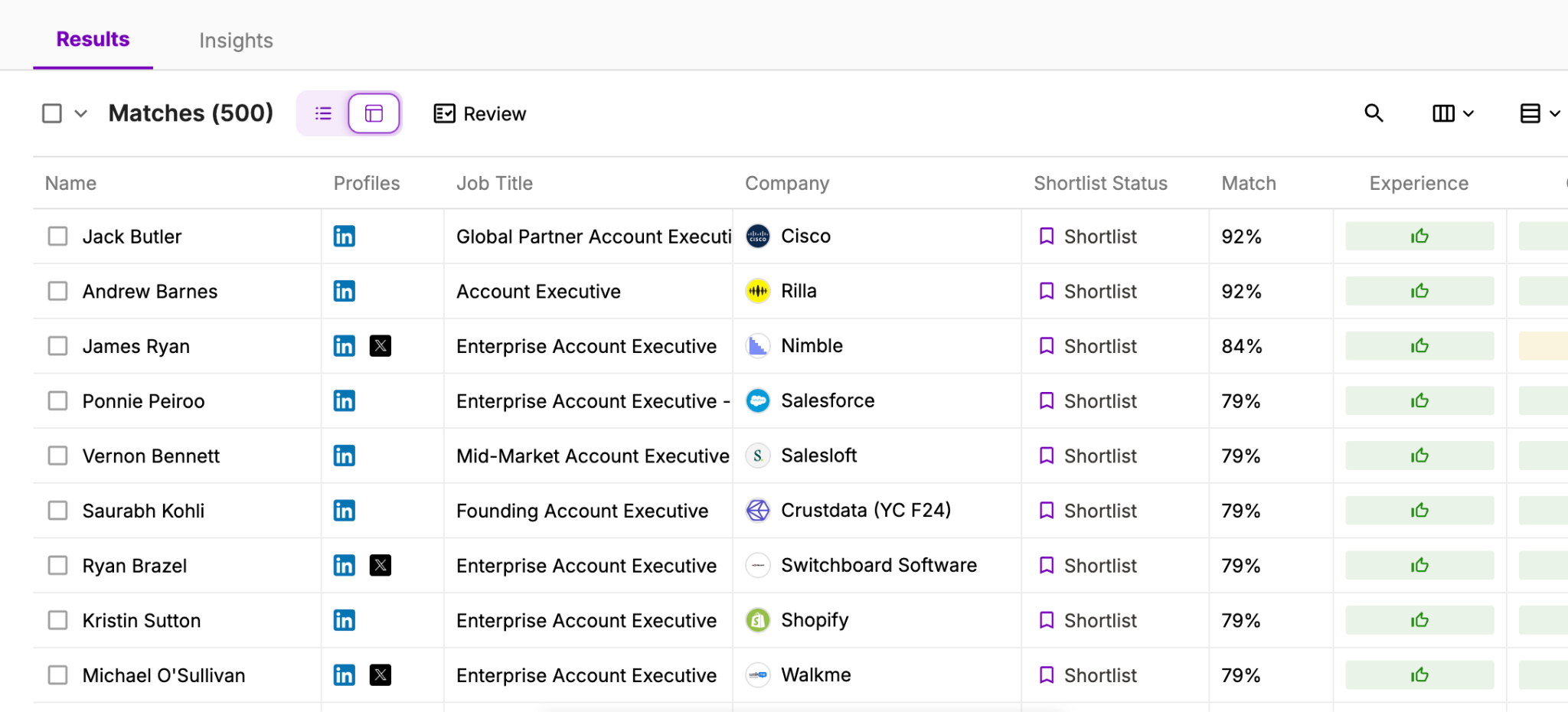
The next step will be to comb through these profiles to find good matches for your outbound.
I spend 1hr a week adding new folks to my Human Capital Pipeline (below). I find doing this Friday afternoons is the best.
Do not do this during your Recruiting Pipe Gen (RPG) times. This is the prep. Prep is key to do BEFORE you start outbounding so when you sit down for your RPG block you are just executing.
Here is a super simple Human Capital Pipeline template to keep you organized if you don’t want to use Juicebox.
Step 2: Attract: Now you need to go on offense
Here’s the thing about recruiting at a Series A that no one wants to hear: The best candidates aren’t applying to your job posting. They’re not even looking.
They’re 110% of quota at a company they know and trust, their manager loves them, and their stock is vesting.
You have to go get them.
And here’s the asymmetry that most leaders don’t use: it is rare for an actual hiring manager to reach out to an AE.
Recruiters reach out all the time. Generic InMails are noise. But when the hiring manager sends a personalized note? Response rates go through the roof.
We hired 6+ AEs cold at Edia in 10 weeks, a Series A edtech company that most AEs had never heard of, by going on offense against our IRP.
The core rule: Sell first. Qualify second.
I see leaders do this backwards constantly.
They lead with “are you open to new opportunities?” They ask about compensation in the first message. They disqualify before they’ve even created interest. That kills the conversation before it starts.
Subscribe and get 5 GTM templates I actually use —> hiring playbooks, rep profiles, outbound scripts, and more. Sent to your inbox immediately.
The Hooks
You need to know your story cold before you send a single message. Here are Siro’s hooks that I built based on what I can see on their site. . Use these as a template and then paste them into your AI of choice and ask it to build the same for your company.
Hook 1: The market nobody is looking at
Gong, Chorus, every other conversation intelligence tool was built for inside sales. Zoom calls. Recorded on a laptop. The field sales rep, the one sitting at someone’s kitchen table closing a $15k home improvement deal, has been completely ignored. That’s 12 million field sales reps in the US alone. Siro is the first company to actually solve this. The TAM is massive and the competition is effectively zero in the space that matters.
Hook 2: The company momentum: $75M raised total. $50M Series B just closed in May 2025. Led by SignalFire. Backed by 01 Advisors (Dick Costolo and Adam Bain), Index Ventures, CRV. This is not a bet. This is a funded rocketship with serious institutional conviction behind it.
Hook 3: Our customers are winning: 36% higher close rates. 30% lower rep turnover. 10x faster coaching cycles. These aren’t vanity numbers. These are the metrics that make a CFO sign a PO.
Hook 4: The Servicetitan & Salesforce partnership: Siro has been embedded with the most consequential software provider in the field services industry (ServiceTitan) and just announced a product partnership with Salesforce ahead of Dreamforce. That’s the distribution. That’s credibility. In a world where software is easy to create, distribution is so key
Hook 5: The earnings opportunity: $$250k OTE at a Series B. Uncapped. If you’re a top performer at a mature company making $180k and wondering when you’re going to catch a real wave, this is the conversation worth having.
Block the time to do Recruiting Pipe Gen (RPG)
We run Pipe Gen Tuesdays at Edia. Reps spend the day outbounding on key accounts. Leaders spend at least 2 hours doing outbound on key AE prospects. Non-negotiable. Tracked weekly.
We don’t rely on TA to fill our pipeline just like our AEs don’t rely on BDRs to fill theirs.
The added benefit: your AEs watch their leaders do something hard every single week. That cultural signal is real.
The outbound message
A message from a hiring manager is 5x more likely to get responded to than a message from a recruiter. The truth is PG is hard, whether it’s for a lead or a recruit, but the rewards can be massive. If you put in the work, you will see the results.
The anatomy of a great outbound recruiting message:
Personalize. One sentence. Something specific. Their company, a promotion, a mutual connection, something they posted. Signals you’re not blasting a template.
The hook. Lead with what’s in it for them. Their career. Their earnings. The opportunity. Not your company overview.
The 8 Mile move. Name the objection before they raise it, then flip it. Disarm the skeptic before they dismiss you.
Clear CTA. Not “let me know if you’re interested.” Give them something specific. One question. One ask.
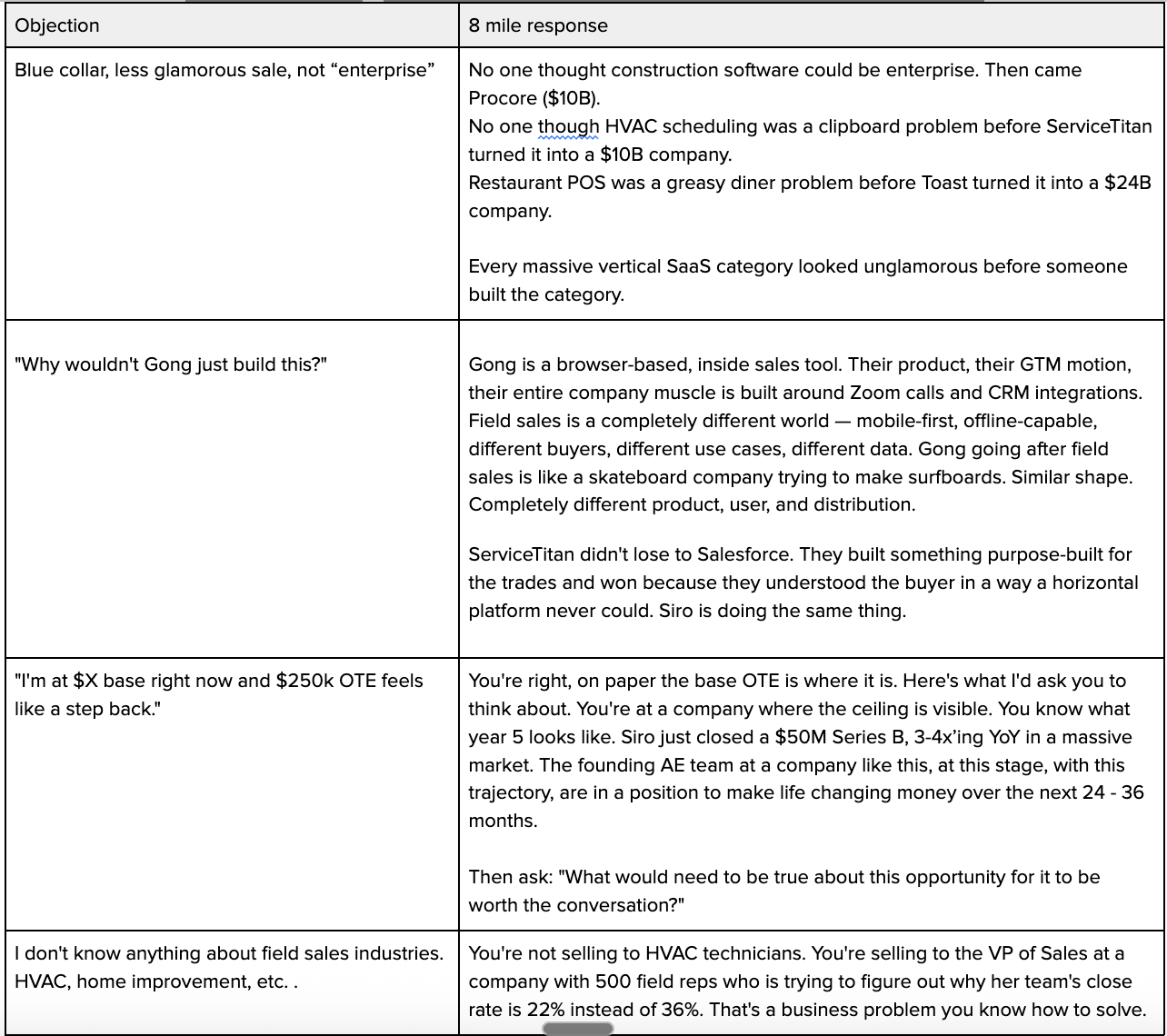
Objections & 8-mile response
Knowing your objections cold is as important as knowing your hooks. The rep who pushes back hard on the opportunity is exactly the rep you want on your team. Don’t get defensive. Meet it directly.
Outbound Templates
Two specific templates you can use today, change to fit your org or role type:
Version 1: The category play
Subject: Field sales AI just raised $50M. Nobody has cracked this yet.
[Name],
Saw your run at [Company] — [X] years closing enterprise deals with real field complexity. That background is exactly what I’m looking for.
I’m building the founding Enterprise AE team at Siro. Quick version of the story:
No one thought restaurant POS was enterprise software. Then came Toast ($24B). No one thought HVAC scheduling could scale. Then came ServiceTitan ($10B). No one thought field sales needed AI. That’s where we come in.
Siro is conversation intelligence for in-person sales. The 12 million field reps that Gong was never built for. We record, transcribe, and analyze real-world sales conversations — at the kitchen table, on the job site, in the showroom. Customers are seeing 36% higher close rates and 10x faster coaching cycles.
$50M Series B just closed. Led by SignalFire. Backed by 01 Advisors, Index Ventures, CRV. Salesforce partnership announced at Dreamforce.
I know the instinct: field sales sounds unglamorous. That’s exactly what people said about construction software before Procore. About legal tech before Harvey. The best GTM bets always look a little weird at first.
$250k OTE. NYC. Uncapped. Founding team seat.
Worth 20 minutes? Open Thursday or Friday.
Ben
Version 2
Subject: You’ve been selling into the real world. So has Siro.
[Name],
Your time at [Company] caught my eye — specifically [the tenure / the move from MM to ENT / selling into services companies]. That trajectory is rare and it’s exactly the profile I’m building around.
I’m the [title] at Siro and I’m putting together the founding Enterprise AE team in NYC.
Here’s the pitch:
Gong changed inside sales forever. Every Zoom call, every email, every digital touchpoint — captured, analyzed, coached. But the 12 million field sales reps sitting at kitchen tables closing $15k home improvement deals? They’ve been completely ignored. No conversation intelligence. No coaching at scale. No visibility for managers.
That’s the problem Siro solves. And it’s a massive one.
We just raised $50M in a Series B led by SignalFire. Customers seeing 36% higher close rates, 30% lower rep turnover.
The objection I always hear: “field sales sounds like door-knockers, not enterprise.” Fair. But the buyer isn’t the HVAC technician. It’s the VP of Sales at a company with 500 reps trying to figure out why her team closes at 22% instead of 40%. That’s an enterprise problem. That’s your deal.
$250k OTE. NYC. Uncapped. Early enough to matter.
If the timing is even slightly right — worth a quick conversation. Thursday or Friday work?
Ben
Step 3: Qualify: Nail the interview process
Five stages. Each with a clear purpose.
Screen Call with Recruiter/Hiring Manager
Topgrading - Tangibles (PG, Champion Building, Qualification ability)
Deep Dive: Intangibles (Drive/Grit, Intelligence, Character, Coachability)
Executive - 2 Cs - Culture and Commitment
Challenge / Presentation
Stage 1: Screen call.
Recruiter or HM. First filter. Basic fit, interest, logistics. Most importantly: keep selling. Don’t flip into full interrogation mode before you’ve established genuine interest.
Stage 2: Topgrading the Tangibles.
Three areas.
1/ Pipeline Generation. Questions to ask:
Tell me about the composition of your book.
How much net new versus existing?
Where do leads come from?
What percentage is self-sourced?
How do you plan your week?
What are your top three target accounts right now, and who specifically are you targeting at each?
Why that person?
The last question is the tell.
A vague answer (”whoever is the decision maker”) means they don’t actually run a disciplined outbound motion.
A specific answer (”I’m targeting the VP of Curriculum because they own the ed tech budget and they just posted about struggling with student proficiency data”) means they know how to hunt.
2/ Champion Building. Questions to ask:
Who’s the champion you’re most proud of building?
Walk me through it.
How did you build them?
How did you know they were a real champion and not just a friendly coach?
Why were they the champion?
I’m listening for specificity.
The rep who says “I built a great relationship with the principal” is not telling me the same thing as the rep who says “I knew she was a champion when she sent me the internal slide deck from their budget meeting unprompted.”
3/ Qualification. Questions to ask:
How do you know if a deal is good or not?
What criteria matter to you when evaluating whether to push or disqualify?
What’s the top reason your deals go closed lost?
The best answer to that last question involves self-awareness.
Not “the competition undercut us on price.”
Something like “I waited too long to identify a real champion and ended up with a coach who couldn’t move the deal when the budget got cut.”
Stage 3: Deep Dive on Intangibles.
This is the most important stage. I take my time here.
Drive/Grit. Questions to ask:
Tell me your story. Don’t accept a resume recitation. Push on the circumstances.
Why did you leave that job?
What led you to make that move? This is where motivation lives.
What’s the hardest thing you’ve ever had to do? Not in sales, in life.
How’d you get into sales in the first place?
I’m looking for a chip on the shoulder. Some version of needing to prove something. The reps who are running toward something are good. The reps who are running away from something are often better.
Intelligence.
Questions to ask:
In the story they just told you, could they explain what the companies they worked for actually do, in simple terms? Not jargon. Simple.
Can they connect facts to conclusions?
If they did something, do they know why it worked?
Can they articulate the insight, not just the action?
Character.
Questions to ask:
Tell me about a deal you lost because of something you did or didn’t do. What did you learn?
If I asked one of your teammates to describe you in three words, what would they say?
Then: who are the top three people you work with? Would you mind if I reached out to them?
That last question is a test in itself. The rep who hesitates, that’s data. The rep who immediately gives you names and says “please do, they’ll tell you everything,” that’s also data.
Back-channel when you can, but be careful here. You don’t want to upset your candidates.
Coachability.
Questions to ask:
What’s the most impactful piece of constructive feedback you’ve received from a manager?
What’s an area of your sales game you know you need to improve, and what have you done about it?
Red flag: “I can’t think of any real feedback, I’ve always exceeded quota.”
Every rep has something. If they can’t name it, they’re either not self-aware or not being honest. Neither is what you want.
Stage 4: The Challenge.
15 minutes: walk me through your territory attack plan for our market.
20 minutes: role play. I’ll be the prospect.
10 minutes: what feedback do you have for me? What questions do you have about the role, the company, the leadership?
That last piece, the candidate’s questions, is one of my favorite signals. The rep who asks sharp, specific questions about attainment, about what success has looked like for top performers, about where the product roadmap is going, that’s someone who’s evaluating you the way you’re evaluating them. That’s who you want.
Stage 5: Executive (The Two Cs).
Culture and Commitment.
Culture: will they thrive in high-growth, high-ambiguity? Give me an example of when you had to pivot fast because the business changed underneath you. What happened? What do you do to continuously improve your sales skills?
Commitment: are they here for the mission or just the paycheck? Why this role, why now, where do you see yourself in three years? I want to hear genuine interest in the problem we’re solving, not just the comp.
At Edia, the mission is changing the life trajectory of every student in America. When a candidate lights up at that, when they have something real to say about education, or about being a first-gen student, or about having a teacher who changed their life, I pay attention.
Always be recruiting.
Celebrate your recruiting wins with your team the same way you celebrate closed deals. Make it a metric.
And remember: the candidate you’re talking to is evaluating you as much as you’re evaluating them.
How you show up in this process, the thoughtfulness of your outreach, the quality of the conversation, how you handle their objections, that’s the first signal they get about what it’s like to work for you.
Make it a good one.
Found this useful?
Subscribe below and share it with a founder or sales leader who’s hiring.
And if you want the Juicebox setup, the HCP template, or the capacity model — drop a comment or shoot me a note.
Amazing. Thanks for the playbook. Applicable well beyond sales. Looking forward to the next one.
Love it - takes me right back to working together. I miss you so much!